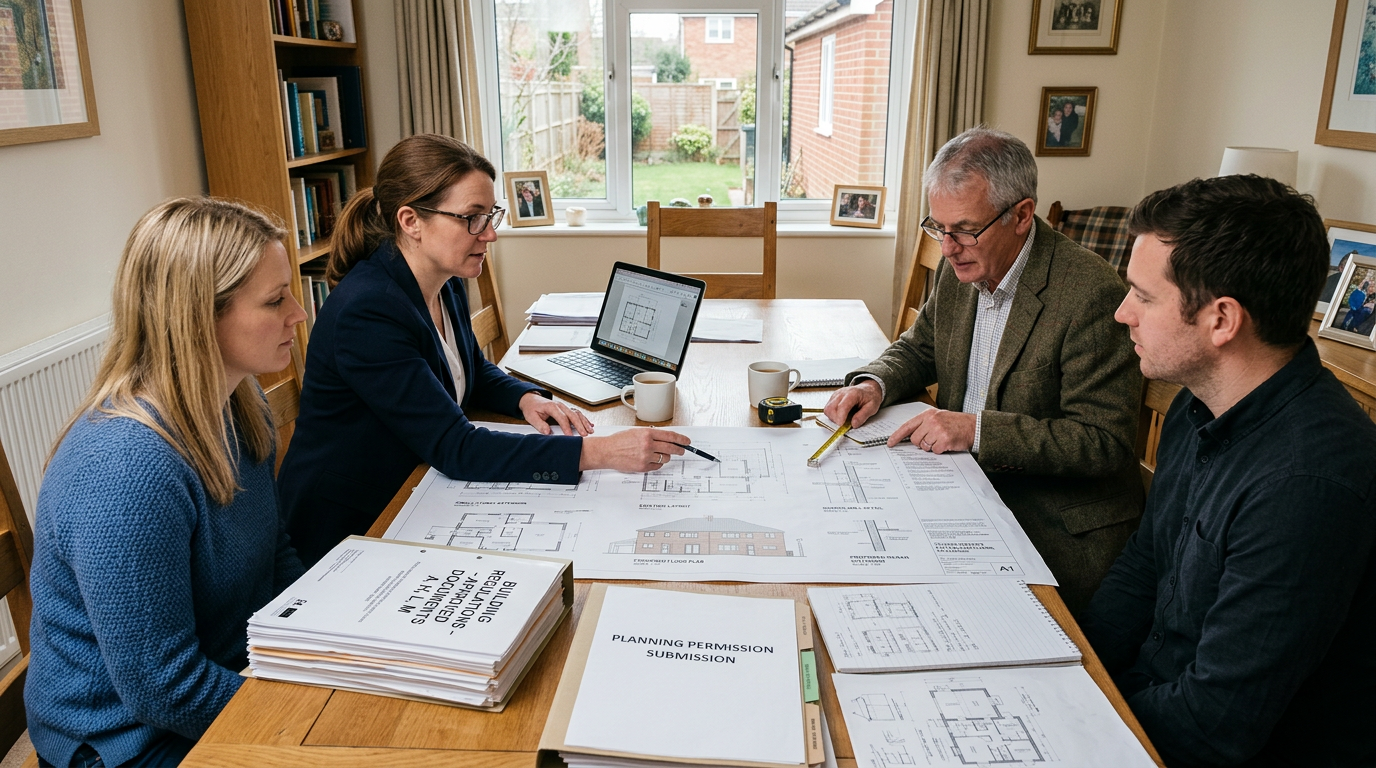
Extending your home is one of the most rewarding — and most financially significant — improvements you can make to a property in Hertfordshire. Whether you're adding a kitchen-diner to the back of your Watford semi, building a side return in Rickmansworth, or adding a double storey in Hemel Hempstead, getting the surveying side right from day one can save you thousands and prevent months of headaches. Here's what you need to know.
Step 1: Understand Your Permitted Development Rights
The first question for most Hertfordshire homeowners planning an extension is: do I need planning permission? In many cases, the answer is no — thanks to Permitted Development (PD) rights, which allow a range of extensions and alterations without a full planning application.
Under current permitted development rules in England (as of 2026), you can generally extend a detached house by up to 8 metres to the rear (or 4 metres for a semi-detached or terraced house) without planning permission — under the Neighbour Consultation Scheme. Single-storey extensions to the rear can extend up to 4 metres for detached homes and 3 metres for others within standard PD rights (no prior approval needed).
However, there are important caveats:
- PD rights don't apply to listed buildings or properties in Conservation Areas
- Extensions must not cover more than 50% of the total area of land around the original house
- Side extensions are typically limited to a single storey and no more than half the width of the original house
- In some Hertfordshire areas, Article 4 Directions have removed PD rights — always check with the local planning authority first
Several Watford and Hertfordshire conservation areas exist — in St Albans city centre, Rickmansworth, and parts of historic Watford. If your property is in or near a conservation area, you may need planning permission for works that would otherwise fall under PD rights. Our surveyors can advise you.
Step 2: Get a Pre-Extension Structural Survey
Before your architect draws a single line, it pays to understand exactly what you're working with. A RICS Level 3 Building Survey (or at minimum a targeted structural inspection) will reveal:
- The condition of your existing foundations — essential if you're extending the footprint
- Any existing structural issues (cracking, settlement, movement) that need addressing before you build
- The type of construction of your current property — some 1960s non-traditional builds have specific requirements
- The condition of the roof if you're planning to extend into the roof space
- Any damp, drainage or other issues that could complicate the build
One of our clients in Abbots Langley came to us after receiving planning approval for a large rear extension. The build was already underway when the contractor discovered the rear wall of the house had significant issues — a concrete-encased steel frame that required specialist treatment before the new foundations could be joined. A pre-extension survey would have caught this and allowed the structural engineer's drawings to account for it from the start, saving around £8,000 in abortive work.
Step 3: Building Regulations Approval
Even if you don't need planning permission, almost all home extensions in Hertfordshire require Building Regulations approval. This is separate from planning and deals with the technical aspects of construction — structural integrity, insulation, drainage, fire safety, ventilation and more.
There are two routes for Building Regs approval:
Full Plans Application
You submit detailed plans to your local council's Building Control department (or an Approved Inspector) before work starts. They review the plans and inspect the work at various stages. This is the more thorough approach and the one we recommend for most extensions.
Building Notice
You notify Building Control and they inspect during the build without pre-approving plans. This is quicker but riskier — if work doesn't comply, you may be asked to open up or redo it.
Step 4: Party Wall Obligations
If your planned extension involves working on or near a shared wall or boundary, you'll need to follow the Party Wall etc. Act 1996 and serve notice on your neighbours. This is a separate legal requirement from both planning and building regulations. We've covered this in detail in our complete guide to party wall agreements — but in brief:
- Rear extensions that involve new foundations within 3 metres of a neighbour's property require a Three-Metre Notice
- Any work directly to a shared wall (e.g., cutting in a beam) requires a Party Structure Notice
- New side extensions that involve building on or very near the boundary require a Line of Junction Notice
You must serve notice at least two months before work begins for party structure notices, and one month for line of junction and three-metre notices. Don't leave this to the last minute.
Step 5: Structural Engineering
Unless your extension is very simple (a small conservatory-style structure, for example), you'll need a structural engineer to design the structural elements — particularly the steel beams and new foundations. Your structural engineer's drawings form part of your Building Regulations application and are also used by the contractor to build correctly.
A good structural engineer and a good surveyor work hand in hand. The surveyor assesses the existing building and flags any concerns; the structural engineer designs the new structure. We work with a number of trusted structural engineers in Hertfordshire and can make introductions if needed.
Common Extension Problems Found During Surveys
Over years of surveying extensions in Watford and across Hertfordshire, we've seen the same problems arise time and again:
Poor Drainage and Guttering
Extension roof valleys and flat roofs are notorious drainage troublespots. Blocked or poorly designed gutters cause water ingress into the junction between old and new. Always make sure drainage is addressed in the design stage.
Inadequate Insulation
Older single-storey extensions often have very poor insulation — particularly in the roof and floor. Modern Building Regulations require significantly higher insulation standards. When buying a property with an older extension, it's worth budgeting for potential insulation upgrades.
Subsidence and Settlement
Extensions built on clay soils — common in south Hertfordshire and north London — can suffer from differential settlement, particularly if the extension foundations are shallower than the original house foundations. This leads to cracking at the junction between old and new. A Level 3 Building Survey will identify any such movement.
Damp at the Old/New Junction
The joint where a new extension meets the original house is a common entry point for damp. If the DPC (damp proof course) hasn't been properly connected and the external rendering or pointing is not properly maintained, damp can track in. Our surveyors check this junction carefully during every inspection.
How Much Does a Home Extension Add to Your Property Value?
This is one of the most common questions we're asked — and the honest answer is: it depends. As a general rule in the Hertfordshire property market:
- A well-designed, high-quality rear kitchen-diner extension can add 5–10% to property value
- A double-storey extension with an additional bedroom and bathroom can add 10–20%
- Loft conversions typically add 10–15% in Watford and surrounding areas
However, these figures assume the work is carried out to a good standard and with all the correct consents in place. Poorly executed extensions — or those done without planning permission or Building Regulations approval — can actually reduce value and make a property harder to sell. Buyers' solicitors will ask for the relevant approvals, and if they don't exist, buyers may renegotiate or walk away.
What About Permitted Development Extensions Done Without a Certificate?
Even if an extension was built under permitted development rights and didn't need planning permission, we strongly recommend obtaining a Lawful Development Certificate (LDC) from your local council. This certificate confirms that the works were lawful at the time of construction and provides formal written evidence for future buyers and their solicitors. Without it, you may face difficulties when you come to sell.
Frequently Asked Questions
Do I need a structural survey before extending my Hertfordshire home?
It's very strongly advisable. A pre-extension structural inspection by a RICS surveyor will identify any existing problems with your building that need to be addressed before you extend — avoiding nasty surprises during the build and potentially saving you significant money.
How long does planning permission take in Watford?
Standard planning applications to Watford Borough Council typically take 8 weeks from validation to decision, though complex applications can take longer. Many straightforward extensions fall under permitted development and don't need a planning application at all. For PD extensions subject to the Neighbour Consultation Scheme, there is a minimum 42-day period.
What is a Lawful Development Certificate and do I need one?
A Lawful Development Certificate (LDC) is a formal written confirmation from the local planning authority that specified works were lawful. Even if you didn't need planning permission, it's very advisable to obtain an LDC to avoid issues when selling the property. It costs a relatively small fee and provides valuable legal certainty.
Does a home extension always require Building Regulations approval?
Almost always, yes. The main exception is a detached outbuilding under 30 square metres. All habitable extensions — including single-storey rear extensions — require Building Regulations approval. Failing to obtain approval can make the property difficult to sell and may require expensive remediation work.
Can a surveyor help me check an extension on a property I'm buying?
Absolutely. Our RICS Level 3 Building Survey covers extensions thoroughly — checking structural integrity, the condition of the roof and walls, drainage, insulation and whether all the correct consents appear to be in place. We'll flag any concerns for your solicitor to investigate further.
Ready to Extend? Start With a Survey
Whether you're planning to extend your Watford home and want a pre-build structural check, or you're buying a property with an existing extension and want it surveyed, our team at Watford Surveyors is here to help. We cover the whole of Hertfordshire, including Watford, St Albans, Hemel Hempstead, Rickmansworth, Bushey, Radlett, Borehamwood and beyond.
Explore our full range of surveying services or contact us today for a no-obligation quote.
Get Expert Advice on Your Hertfordshire Extension
Our RICS-accredited surveyors can check your existing home's structure, advise on party wall obligations and help you plan your extension with confidence.
Get a Free Quote View Level 3 Survey