Buying a leasehold flat in Watford, St Albans, or anywhere across Hertfordshire is an exciting step — but it comes with a unique set of legal and structural considerations that freehold buyers never encounter. One of the most common misconceptions we hear from clients is: "Do I really need a survey on a leasehold flat?"
The short answer is yes — absolutely. As RICS surveyors based in Watford, our team has seen first-hand how leasehold purchases can go badly wrong when buyers skip the survey or assume the building is covered by their management company. In this guide, Sarah Mitchell — one of our senior surveyors — walks you through everything you need to know about commissioning a property survey on a leasehold flat in Hertfordshire.
🔑 Key Takeaways
- Leasehold flat buyers still need a RICS Level 2 or Level 3 survey — don't rely on the freeholder's maintenance records alone
- Short leases (under 80 years) can seriously affect mortgage eligibility and resale value
- Service charge and ground rent reviews can significantly increase the long-term cost of ownership
- A surveyor can identify structural problems in your flat and flag potential issues with the wider building
- Always instruct a solicitor to review the lease alongside your survey, not instead of it
What Is Leasehold? A Quick Primer for Hertfordshire Buyers
When you buy a leasehold property, you own the property for a fixed period — the "term" of the lease — but you do not own the land or building it sits in. The freeholder (or their managing agent) retains ownership of the structure, communal areas, and land. Leasehold is the most common way to own a flat in England and Wales, and Watford has a large number of leasehold properties — from purpose-built 1970s blocks in Oxhey to modern new-build apartments in the town centre.
The leasehold system means you will pay an annual ground rent (in many older leases), contribute to a service charge to cover building maintenance, and seek permission from the freeholder for alterations to the property. Understanding these obligations before you buy is essential — and a property survey is one of the best ways to assess what maintenance liabilities you may be taking on.
Why You Still Need a Survey on a Leasehold Flat
Many buyers wrongly assume that because the freeholder manages the building, they don't need to worry about structural matters. This is a dangerous misconception. Here's why a survey remains vital:
1. The Freeholder Isn't Always on Your Side
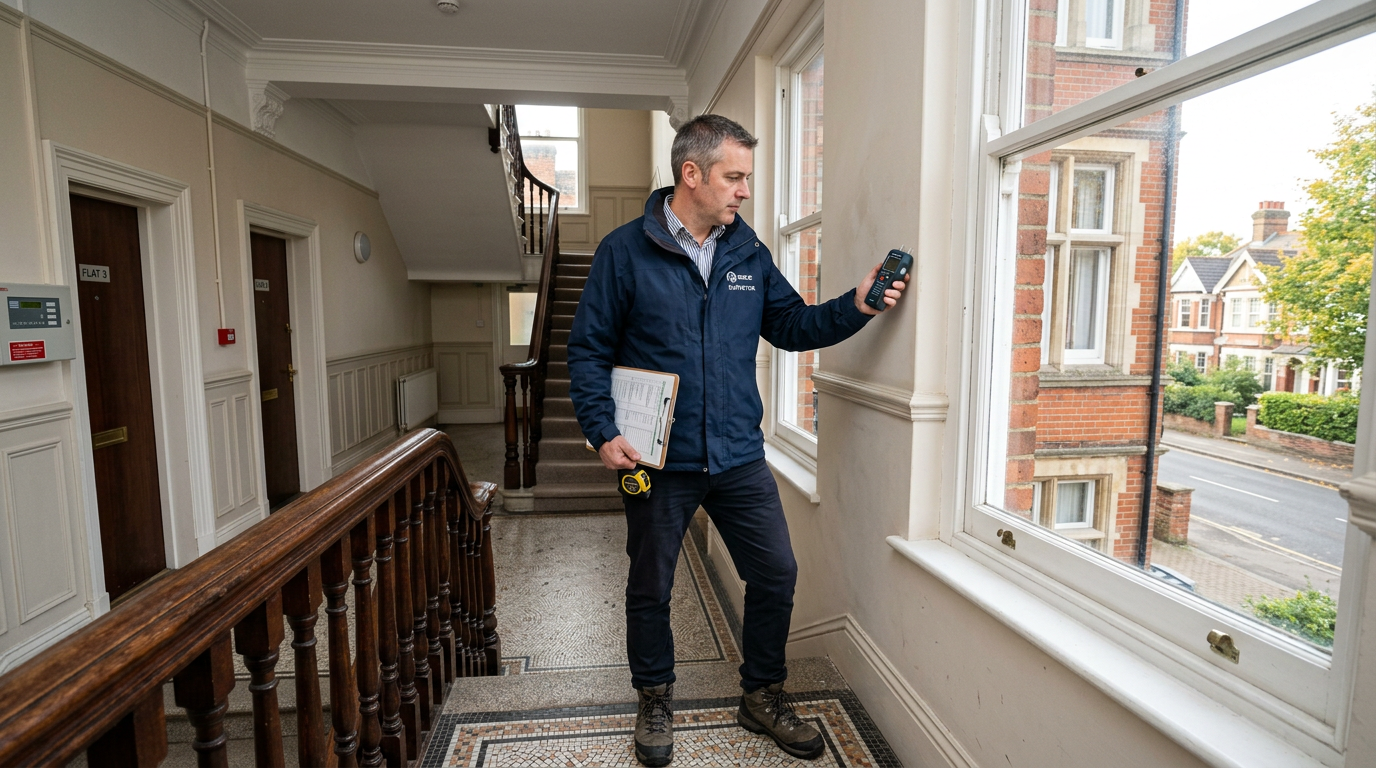
The freeholder is responsible for the fabric of the building — roofs, external walls, foundations — but their interests may not align with yours. If a roof is failing, a managing agent may delay expensive repairs, leaving you living with leaks for years. A RICS surveyor will examine the interior of your flat and, where accessible, comment on the condition of communal areas and visible external elements, giving you an independent picture of the building's health before you commit.
2. Your Flat Has Its Own Defects
Even in a well-maintained block, individual flats can suffer from damp penetration through walls shared with external facades, condensation issues, poorly fitted kitchens and bathrooms, inadequate insulation, and defective windows. None of these will be picked up by the freeholder's maintenance regime — they are your responsibility the moment you complete. A RICS Level 2 Home Survey will identify all of these issues using a traffic-light rating system, so you know exactly what you're taking on.
3. Service Charge Liabilities Can Be Enormous
If the building needs major work — a new roof, external cladding remediation, lift replacement — the cost is divided among leaseholders via a "major works" contribution. In Watford, we have seen flat owners receive bills of £15,000–£50,000 or more for major works they had no idea were on the horizon. While a surveyor cannot predict future service charge demands with certainty, they can inspect visible elements of the building and flag areas that look likely to require significant expenditure in the near term.
4. Cladding and Fire Safety Concerns
Since the Grenfell Tower tragedy, fire safety has become a critical issue for leasehold flat buyers across the UK. Buildings with EWS1 (External Wall System) issues can be unmortgageable. Your surveyor will note any concerns about external wall construction, and can advise whether you need a specialist fire safety assessment before proceeding.
Understanding Lease Length: Why It Matters So Much
The remaining term on a lease has a direct and significant impact on both your ability to get a mortgage and the future resale value of the property. Here is what you need to know:
- Over 90 years remaining: No immediate problem. Most mortgage lenders are comfortable with this level of term.
- 80–90 years remaining: Factor in the cost of lease extension — the "marriage value" threshold has not yet been reached, keeping extension premiums lower.
- Under 80 years remaining: The "marriage value" kicks in under the Leasehold Reform Act, making lease extension significantly more expensive. Many mortgage lenders will refuse to lend on a lease with fewer than 70–75 years remaining.
- Under 70 years remaining: Many high-street lenders will refuse to lend at all. Negotiate a lease extension as part of the purchase, or factor the extension cost into your offer price.
Your solicitor will check the lease length as part of the conveyancing process, but your surveyor is often the first professional to flag this as a concern. At Watford Surveyors, we always note the lease length in our reports and advise clients accordingly.
Ground Rent: What Changed in 2022
The Leasehold Reform (Ground Rent) Act 2022 banned ground rents on new residential leases in England and Wales — meaning any lease granted after 30 June 2022 must have a peppercorn (zero) ground rent. However, millions of existing leases still contain ground rent provisions, and some are extremely problematic:
- Doubling ground rent clauses: Some leases contain clauses that double the ground rent every 10 or 25 years — a ground rent that starts at £250 and doubles every 10 years becomes £8,000 a year within 50 years.
- RPI-linked ground rent: Ground rents linked to the Retail Price Index can rise substantially and may also trigger mortgage lender concerns.
- High fixed ground rent: Ground rents over £250 per year (or £1,000 in London) bring the lease under the Housing Act 1988, potentially classifying the property as an assured tenancy.

What Does a Leasehold Flat Survey Cover?
When you commission a RICS Level 2 Home Survey or a RICS Level 3 Building Survey on a leasehold flat in Watford or Hertfordshire, your surveyor will inspect:
Inside Your Flat
- Condition of internal walls, ceilings, and floors
- Evidence of damp — rising damp, penetrating damp, or condensation
- Condition of kitchen and bathroom fixtures and fittings
- Windows and doors — operation, draught-proofing, and glazing condition
- Electrical installation (visual inspection only)
- Heating system (visual inspection and functional check)
- Any visible structural movement — cracking in walls, uneven floors
- Evidence of previous unauthorised alterations or undisclosed works
Communal and External Elements (Where Accessible)
- Roof coverings and any accessible roof terraces
- External walls and cladding — condition and materials
- Communal corridors, stairwells, and entrance areas
- Visible drainage and guttering
- Any obvious fire safety concerns
Level 2 vs Level 3 Survey for a Leasehold Flat
For most leasehold flats in Watford — particularly modern purpose-built blocks and relatively straightforward conversions — a RICS Level 2 Home Survey is the most appropriate choice. It provides a comprehensive condition report using the traffic-light rating system and gives you a clear picture of the flat's condition.
However, a RICS Level 3 Building Survey may be more appropriate if:
- The flat is in a converted Victorian or Edwardian property rather than a purpose-built block
- The building is listed or in a conservation area
- You have seen visible signs of structural problems during viewings — cracks, sloping floors, significant damp
- The property is unusual in construction or has had significant alterations
- You are planning major renovation works after purchase
"A client came to us wanting a Level 2 on a leasehold flat in central Watford. During the inspection, I noticed significant penetrating damp on the external wall and evidence the communal roof above had been patched repeatedly. The service charge reserve fund stood at just £4,000 — far below what was needed. Armed with this information, the client renegotiated the purchase price by £18,000, which more than covered the anticipated works." — Sarah Mitchell, Surveyor
Frequently Asked Questions
Do I need a survey if the building is new-build?
Can I use the freeholder's survey instead of commissioning my own?
Should I get a survey even if the mortgage lender is sending a valuer?
How much does a leasehold flat survey cost in Watford?
Ready to Book Your Leasehold Flat Survey in Watford?
Our RICS surveyors cover leasehold properties across Watford, St Albans, Hemel Hempstead, Rickmansworth, Bushey, and all of Hertfordshire. Free quote, no obligation.
Related reading: Level 2 vs Level 3 survey — which do you need? | First-time buyer's complete guide to surveys in Hertfordshire | How to negotiate after a survey