The roof is often the single most expensive element of a property to repair or replace. Yet it's also one of the least visible — and most frequently neglected. As building surveyors in Watford, we've seen roof problems cause everything from minor inconvenience to catastrophic structural damage. Here's exactly what we check, and why it matters.
🔑 Key Takeaways
- Roof replacement costs £6,000–£20,000+ for a typical Hertfordshire semi or detached house
- Most roof problems start small — regular maintenance is far cheaper than full replacement
- Our surveyors inspect the roof from ground level, via binoculars and ladder where safe, and from within the roof space
- Flat roofs, extensions and dormers require particularly careful attention
Why the Roof Matters So Much in Watford's Housing Stock
Watford and Hertfordshire have a huge amount of Victorian and Edwardian housing — properties with pitched roofs of natural Welsh slate or plain clay tiles, many of which are now well over 100 years old. While both materials are incredibly durable when properly maintained, they're not immortal. Old ridge tiles fail. Valleys fill with debris. Lead flashings crack. Gutters block and overflow, saturating the fabric of the building.
For properties built from the 1960s onwards, concrete tiles are common — these can become porous with age, leading to moss growth and water ingress. And then there are the flat roofs: extensions, outbuildings, dormer cheeks — often the weakest link in the building's weatherproofing.
What Our Surveyors Check on the Roof
Roof Covering (Tiles, Slates, Felt)
We examine the roof covering from ground level (using binoculars if needed) and from within the roof space, looking for: missing, slipped, cracked or broken tiles or slates; perished or missing mortar bedding to ridge tiles; signs of temporary or previous repairs; condition of any roofing felt visible in the loft.
Ridge and Hip Tiles
The ridge runs along the apex of the roof, and hip tiles protect the angled corners. Both are bedded in mortar, which degrades over time. Loose ridge tiles are a very common finding in Watford and Hertfordshire properties and can cause significant water ingress if not addressed. This is typically a straightforward repair costing £500–£1,500.
Chimney Stacks and Flashings
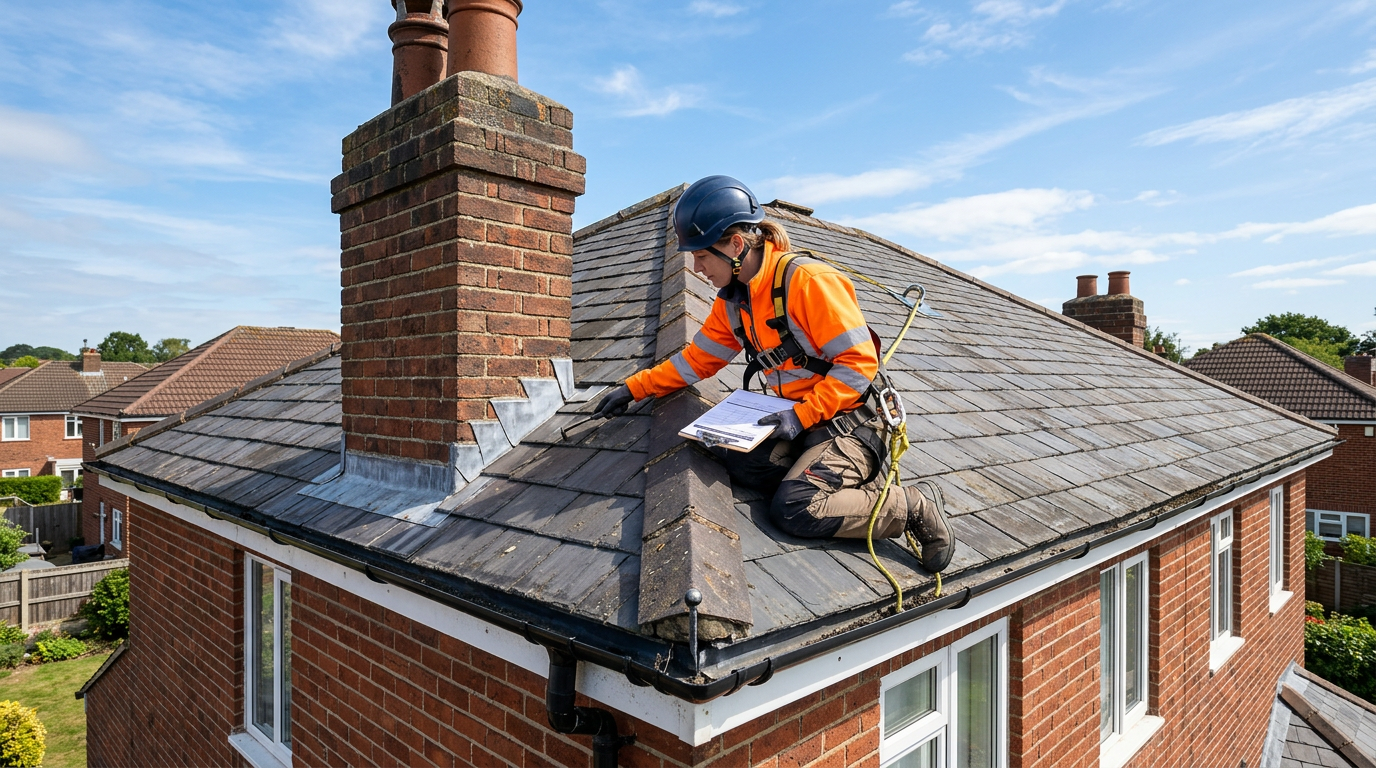
Chimney stacks are one of the most problematic elements of older properties. We look for: cracked or spalling brickwork; failed mortar pointing (repointing a chimney costs £500–£1,500); defective or missing lead flashings where the chimney meets the roof slope (the most common source of water ingress); and the condition of the chimney pot and haunching.
Valleys, Gutters and Rainwater Goods
Valleys — the internal angles where two roof slopes meet — are a common point of failure. Lead valleys degrade and crack; mortar valleys can crack and fail; underfelt and tile valleys can block with debris. We also check the gutters, downpipes and all external rainwater goods, which are a primary cause of penetrating damp when blocked or damaged.
Flat Roofs
Flat roofs on extensions are often the most vulnerable part of a property. Traditional felt flat roofs have a lifespan of around 10–15 years and are frequently found to be at or past the end of their life on older Watford properties. We check for blistering, cracking, ponding water and any signs of leaks visible from inside.
Roof Structure (From the Loft)
Where accessible, we inspect the roof structure from inside the roof space, looking for: evidence of water ingress (staining on rafters and felt); signs of timber decay or woodworm; adequacy of strapping and bracing; and whether any alterations (such as loft conversions) have compromised the original roof structure.
Common Roof Problems Found in Watford Properties
- Slipped or missing slates (particularly on pre-war properties) — repair: £200–£800
- Failed mortar to ridge tiles — repair: £500–£1,500
- Defective chimney flashings — repair: £400–£1,200
- Failed flat roof on extension — replacement: £1,500–£5,000
- Blocked or damaged gutters — repair: £150–£500
- Full re-roofing of a typical 3-bed semi: £6,000–£12,000
What Happens If a Roof Problem Is Found?
Your surveyor will assign it a Condition Rating of 2 (monitor/repair when possible) or 3 (urgent attention required) depending on severity. For Level 3 surveys, estimated repair costs will be included in the report. You can use this to negotiate with the seller or factor the cost into your renovation budget.
Buying a Property With a Suspected Roof Problem?
Our RICS surveyors will carry out a thorough roof inspection as part of your Level 2 or Level 3 survey. Don't risk buying a property with hidden roof issues.
Related: 10 structural warning signs | Damp in Watford homes | Level 2 vs Level 3 survey