Subsidence is one of the most feared words in property buying. Mention it at a dinner party among homeowners in Watford and you will watch the room fall silent. But how serious is it really? And what should you do if a property survey flags foundation movement at a home you want to buy in Hertfordshire?
As lead surveyor at Watford Surveyors, James Thornton carries out dozens of Level 2 and Level 3 building surveys across Watford, St Albans, Hemel Hempstead, and the wider county every year. Subsidence — and its closely related cousins, settlement and heave — comes up regularly. In this guide, we cut through the fear and give you a clear, practical understanding of what foundation movement actually means, why parts of Hertfordshire are more at risk than others, and what your options are if it affects a property you are considering buying.
🔑 Key Takeaways
- Not all cracks indicate subsidence — most are the result of normal thermal or moisture-related movement
- Parts of Hertfordshire — especially clay-rich areas around Watford and St Albans — have elevated subsidence risk due to shrink-swell soils
- Subsidence must be declared to buyers and insurers — you cannot legally conceal it
- A RICS Level 3 Building Survey is strongly recommended for any property showing signs of structural movement
- Remediated and monitored subsidence need not prevent you from buying — the right professional advice is key
What Is Subsidence? Distinguishing it from Settlement and Heave
These three terms are often used interchangeably, but they have distinct meanings that matter when assessing a property:
Subsidence
Subsidence occurs when the ground beneath a building's foundations loses volume and sinks downward, causing the foundations — and the building above them — to drop. This can happen unevenly, so one part of the building drops more than another, creating differential movement that places enormous stress on the structure. The result is often diagonal cracking through brickwork, sticking doors and windows, and visible distortion of the building's lines.
Settlement
Settlement is a natural process that affects almost every new or recently extended building. As the weight of a structure is gradually transferred into the ground, the soil compresses slightly, causing a small but measurable downward movement. This is usually predictable, uniform, and limited in extent — most buildings settle by a few millimetres in the first few years after construction and then stabilise. Settlement cracks are typically narrow, horizontal or vertical, and do not progress over time once the building has stabilised.
Heave
Heave is the opposite of subsidence — the ground swells upward, pushing the foundations and building upward. It most commonly occurs when clay soils that had previously been dried out by tree roots become re-wetted after the removal of nearby vegetation. The clay absorbs moisture and expands, sometimes dramatically. Heave is in some ways more serious than subsidence because it can affect foundations from below with considerable force, and it tends to affect the central areas of a building rather than the perimeter.
Why Is Hertfordshire at Particular Risk?
Hertfordshire sits on a complex mix of geological deposits, and the risk of subsidence is not uniform across the county. The British Geological Survey (BGS) produces shrink-swell susceptibility maps, and much of the county — particularly the areas around Watford, St Albans, Hemel Hempstead, and Radlett — sits on London Clay and related deposits that are highly susceptible to volume changes.
London Clay and Shrink-Swell Behaviour
London Clay is notoriously susceptible to shrink-swell behaviour. In dry summers, the clay loses moisture and shrinks significantly. In wet autumns and winters, it reabsorbs water and swells. This annual cycle places recurring stress on foundations — particularly shallow foundations typical of Victorian and Edwardian properties — and over many years can cause progressive and cumulative movement.
Climate change is making this problem worse. Hotter, drier summers cause greater clay desiccation, and the UK has seen an increase in subsidence insurance claims during and after the prolonged dry spells of recent years. According to the Association of British Insurers, subsidence claims across the UK spiked significantly following the summer of 2022.
Trees and Vegetation
Trees are one of the primary drivers of subsidence on clay soils. Tree roots extract enormous quantities of moisture from the soil — a mature oak in Hertfordshire can transpire hundreds of litres of water on a hot day. When trees are planted close to buildings, their roots can extend beneath the foundations and draw out the clay moisture that keeps the soil volume stable.
High-water-demand species are the most commonly implicated: oak, willow, poplar, ash, and elm. But even smaller trees and large shrubs — including leylandii hedges — can cause problems when planted close to older, shallow-founded buildings. At Watford Surveyors, we always note the presence and species of nearby trees in our surveys and assess the potential risk they pose relative to the building's foundation depth and soil type.
Drainage Failures
Leaking underground drainage is another significant cause of foundation movement in Hertfordshire. When a drain or sewer pipe develops a crack or joint failure, water escapes into the surrounding soil. On clay soils, this can cause swelling and heave. On sandy or gravelly soils, running water can wash away fine particles from beneath the foundations — a process called "undermining" — causing the ground to collapse. Old clay-pipe drainage systems, common in pre-1960s properties across Watford and its surrounding towns, are particularly prone to this problem.
Warning Signs of Subsidence: What to Look For
As a buyer visiting a property in Hertfordshire, there are several visual warning signs that should prompt you to commission a thorough structural survey:
Cracks: The Key Indicators
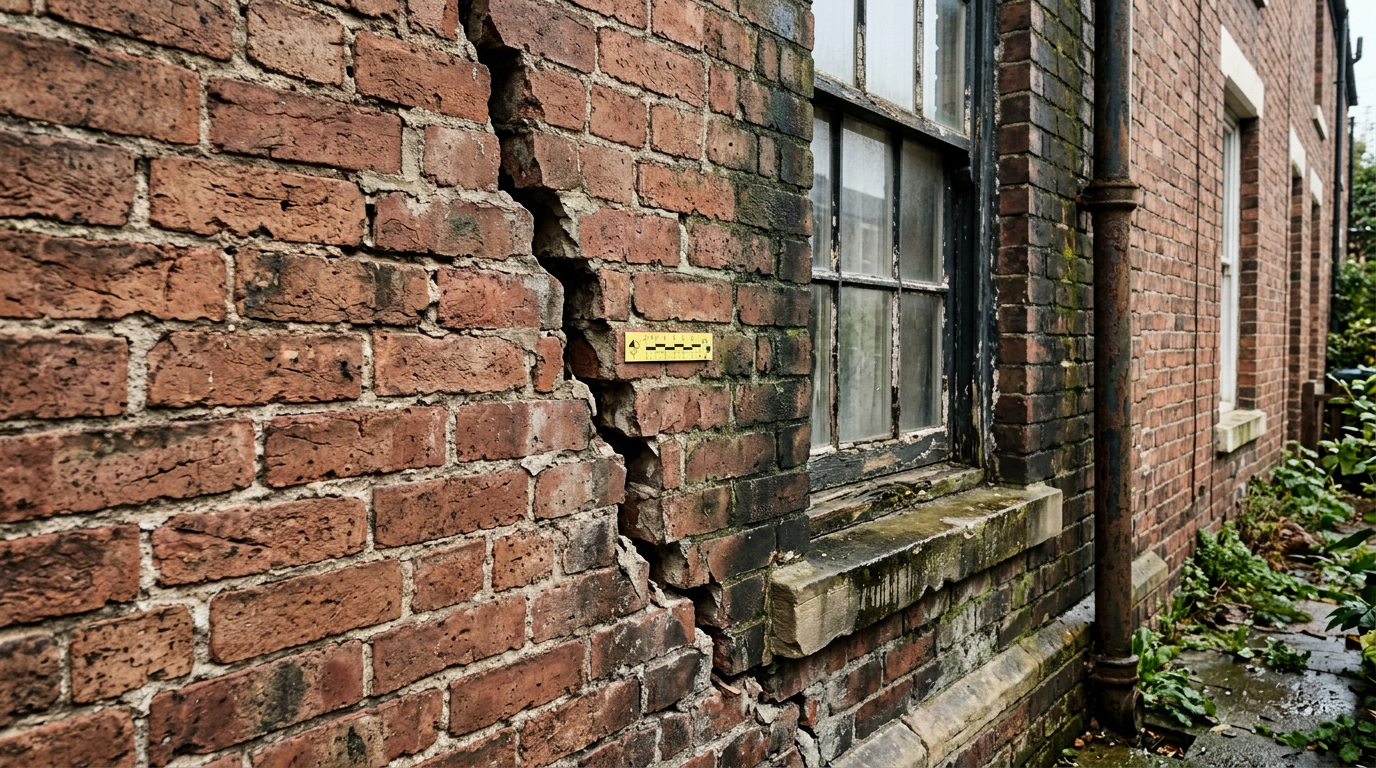
Not all cracks indicate subsidence — far from it. Most buildings have some minor cracking as a result of normal thermal expansion and contraction or minor settlement. The cracks that concern structural surveyors have specific characteristics:
- Diagonal cracks running at approximately 45 degrees through brickwork, especially around door and window openings, are the most common sign of differential foundation movement
- Tapered cracks — wider at the top than the bottom (or vice versa) — indicate that one part of the structure has moved relative to another
- Cracks wider than 3mm are generally considered more significant than hairline cracks
- Cracks that pass through bricks as well as mortar joints, rather than just following the line of the mortar, are more serious
- Recent or active cracks — with fresh edges, no dust accumulation, or that have been filled and reopened — suggest ongoing movement rather than historic, stable cracking
- Multiple cracks in a pattern radiating from corners of windows and doors on one side of a building can indicate differential settlement between two areas of the foundation
Other Physical Signs
- Sticking doors and windows — particularly those that have recently begun to stick despite no changes to the property or its heating — can indicate structural frame distortion
- Gaps between the external wall and internal linings, or between the ceiling and walls, suggest relative movement between structural elements
- Sloping floors that are notably out of level, particularly in ground floor rooms, can indicate foundation movement
- Rippled or undulating wall surfaces can indicate that masonry has been distorted by movement below
- Evidence of previous repairs — carefully repointed brickwork, freshly plastered walls, or new paint over localised areas — can sometimes indicate an attempt to conceal cracking and warrants closer investigation
Classifying Structural Damage: The BRE Categories
The Building Research Establishment (BRE) provides a widely used classification system for assessing the severity of structural damage from subsidence. Your RICS surveyor will reference this in their report:
| BRE Category | Crack Width | Description & Action |
|---|---|---|
| 0 — Negligible | Less than 0.1mm | Hairline cracks. No action required. |
| 1 — Very Slight | Up to 1mm | Fine cracks that can be redecorated. Not generally visible externally. |
| 2 — Slight | Up to 5mm | Cracks can be filled and redecorated. Possible slight sticking of doors and windows. |
| 3 — Moderate | 5–15mm | Cracks require opening up and patching. Doors and windows sticking. Repointing required. |
| 4 — Severe | 15–25mm | Major repair required. Windows, doors and floors distorted. Service pipes disrupted. |
| 5 — Very Severe | Over 25mm | Structural integrity at risk. Major repair or rebuilding required. Underpinning likely. |
What Happens During a Structural Survey?
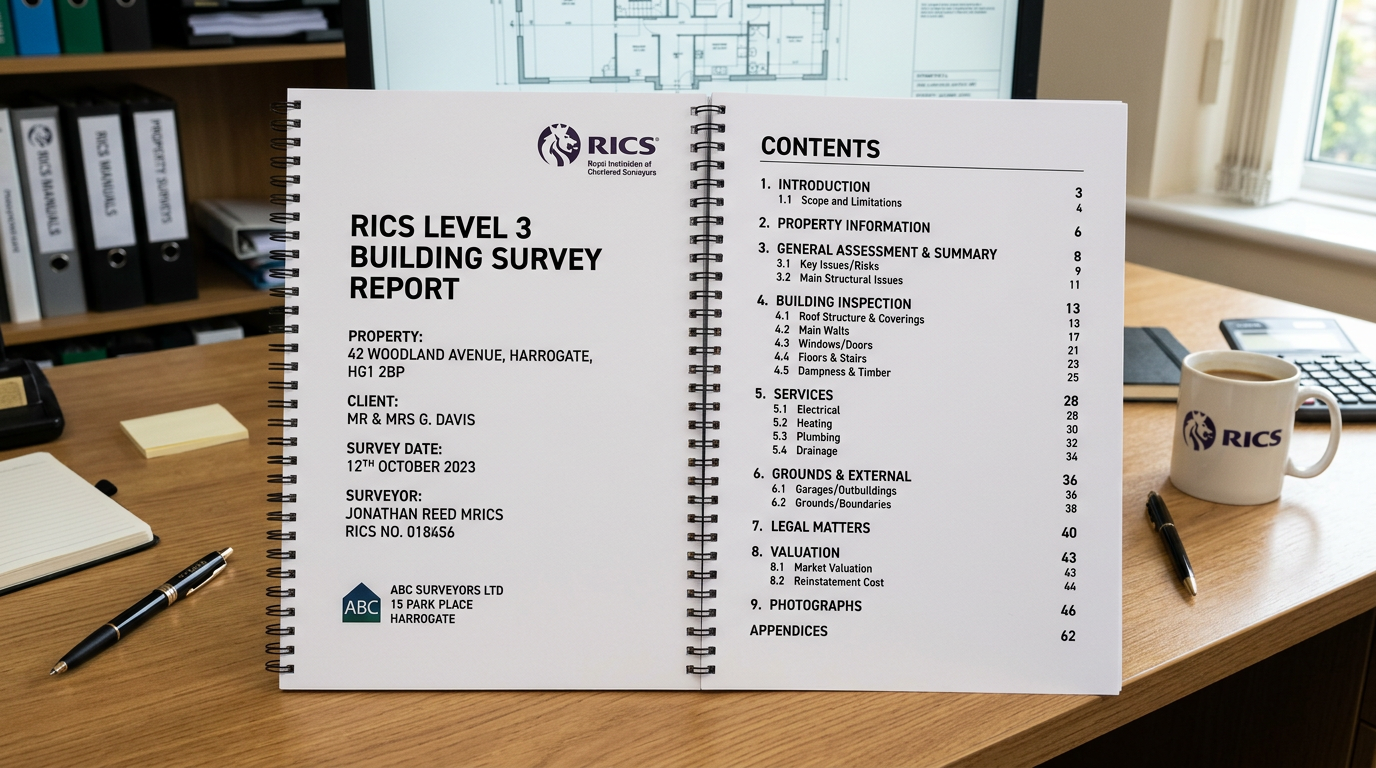
If you commission a RICS Level 3 Building Survey on a property in Watford or Hertfordshire that shows signs of structural movement, your surveyor will carry out a systematic and thorough investigation:
Visual Inspection
The surveyor will conduct a detailed visual inspection of all accessible elements of the building, both externally and internally. They will note and measure cracks, assess their width, orientation, and pattern, and make a judgement about whether they appear to be active (ongoing movement) or historic (settled and stable).
Floor Level Survey
In some cases — particularly where floor-level distortion is suspected — your surveyor may use a spirit level or digital level meter to assess the slope and undulation of floor surfaces. This gives a quantitative picture of how much movement has occurred.
Tree Assessment
The surveyor will note the species, approximate height, and proximity of any trees to the building, and assess the likely root influence zone relative to the foundation depth. They will consider whether any trees have been recently removed — as this can be a trigger for heave — and whether the soil type increases the risk.
Drainage Inspection Recommendation
Where drainage failure is suspected as a contributory cause, your surveyor will recommend a CCTV drain survey. This involves passing a small camera through the drainage system to inspect the pipework for cracks, root intrusion, and displaced joints. This specialist service is relatively inexpensive (typically £150–£300) and can provide crucial evidence about the cause and extent of any ground movement.
What Are the Options If Subsidence Is Confirmed?
A confirmed history of subsidence does not automatically mean you should walk away from a property. The key questions are: Is the movement ongoing, or has it stabilised? What caused it? Has it been properly remediated?
Monitor and Wait
If the cracking appears historic and there are no signs of recent movement, a structural engineer may recommend a monitoring programme — typically involving the installation of tell-tales (crack monitors) and level surveys over six to twelve months — to confirm that the building is stable before making any repair decisions. This is a common approach for BRE Category 2–3 damage.
Address the Root Cause
Where a specific cause has been identified — a leaking drain, a nearby tree — addressing that cause may be sufficient to arrest the movement. Drain repairs can prevent further soil loss, and careful tree management can halt clay desiccation. This approach is preferable to underpinning where it is sufficient to resolve the problem.
Underpinning
Underpinning is the process of strengthening or deepening the foundations of a building to provide a more stable bearing stratum below the zone of clay movement. Traditional mass concrete underpinning involves excavating beneath the existing foundations in a series of short bays and filling with concrete. More modern systems — including mini-pile underpinning and resin injection — are less disruptive and increasingly common. Underpinning costs in Hertfordshire typically range from £10,000 to £50,000 or more depending on the extent of work required.
A Real-Life Example From Our Surveyors
"We were asked to carry out a Level 3 Building Survey on a 1930s semi-detached house in Watford. During the inspection, I identified Category 3 diagonal cracking on the front elevation, associated sticking of the front bay window, and a large willow tree approximately 4 metres from the front wall. The vendors disclosed a previous subsidence claim but had no structural engineer's report confirming stabilisation. A CCTV drain survey revealed a partially collapsed clay pipe near the front elevation. The buyer used this information to negotiate a £22,000 reduction from the asking price, covering drain repairs, crack filling, repointing, and a contingency for further remedial work." — James Thornton, Surveyor
Buying a Property with a Subsidence History: Key Considerations
Many properties in Watford and across Hertfordshire have a history of subsidence — particularly Victorian terraces and semi-detached houses in clay-rich areas. A previous subsidence history does not necessarily make a property a bad buy, but it does require careful investigation:
- Obtain the insurance history: Sellers are legally obliged to disclose known subsidence. Ask for any previous insurance claims and the outcome
- Review structural engineer's reports: If underpinning was carried out, there should be a structural engineer's report and a completion certificate — ask to see these
- Check warranty documentation: For newer properties, check whether any structural warranty covers foundation movement
- Obtain specialist insurance quotes: Subsidence-affected properties may require specialist buildings insurance — get quotes before you exchange
- Negotiate the price: A property with a subsidence history will typically be priced lower than comparable unaffected properties — use the survey findings to negotiate a realistic price
Frequently Asked Questions
Should I walk away from a property with subsidence?
Can I get a mortgage on a property with subsidence?
Do I need a Level 3 survey if I think subsidence may be present?
How much does subsidence cost to fix in Hertfordshire?
Concerned About Subsidence? Book a Structural Survey Today
Our RICS Level 3 Building Survey covers properties across Watford, St Albans, Hemel Hempstead, Rickmansworth, Bushey, and all of Hertfordshire. Free quote, no obligation.
Related reading: 10 warning signs of structural problems in Hertfordshire homes | Level 2 vs Level 3 survey — which do you need? | How to negotiate after a survey